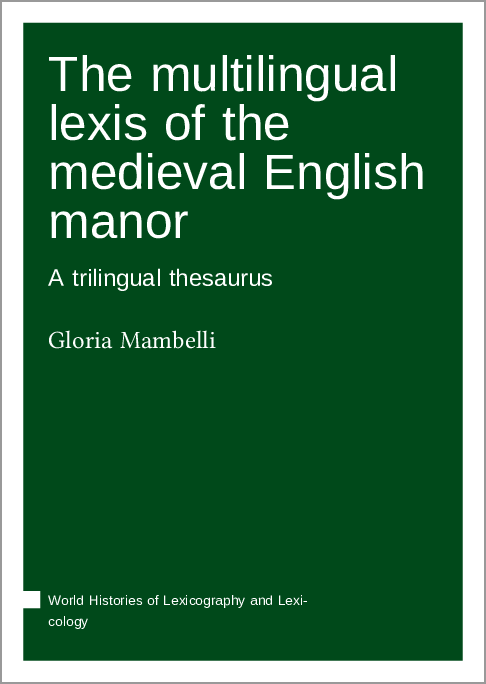
Forthcoming: The multilingual lexis of the medieval English manor: A trilingual thesaurus

Gloria Mambelli

Keywords:

historical linguistics, historical lexicography, Middle English, language contact, multilingualism

Synopsis

This book presents and examines a thesaurus of Anglo-French, Medieval Latin, and Middle English vocabulary associated with one of the key institutions of medieval England: the medieval manor. This lexicographical resource was specifically compiled to investigate the effects of language contact on an underexplored lexical domain associated with rural contexts of medieval England, as well as to address a gap in historical lexicography.

Notwithstanding the extensive treatment of lexical borrowing in English historical linguistic studies and the increasing academic interest in the multilingual situation characterising post-Conquest England, certain areas of the Middle English lexicon, particularly those associated with non-elite and rural contexts, deserve further investigation from a contact linguistic perspective. Although recent studies of the vocabulary of medieval occupations have challenged the conventional assumption that borrowing from French mainly affected lexical domains associated with the ruling elite (Sylvester and Marcus 2017; Ingham et al. 2019; Sylvester et al. 2020), the effects of language contact on the vocabulary of the medieval countryside remain underinvestigated, likely due to its association with a predominantly anglophone environment.

In addition, recent scholarship focusing on multilingualism in post-Conquest England (cf. Trotter 2000; Wright 2020, among others) has attempted to shed light on the medieval perceptions of language boundaries, exploring language-mixing practices and highlighting the issues posed by monolingual lexicography, to show that the three medieval languages “cannot be studied in isolation” (Schendl 2015a: 15). In particular, Trotter advocated for “an onomasiological treatment of later medieval England” (i.e. starting from concepts to identify the terms used to express them) to show the interplay between the three languages (1996: 31). However, the multilingual lexis attested in the centuries following the Norman Conquest is still scattered across distinct dictionaries (the Middle English Dictionary, the Anglo-Norman Dictionary, and the Dictionary of Medieval Latin from British Sources). Although the Bilingual Thesaurus of Everyday Life in Medieval England was recently compiled to address this issue by capturing the overlapping use of the Anglo-French and Middle English vocabulary of medieval occupations, it does not include Latin, the main language of record at the time. As a result, a thesaurus covering the three medieval languages is not available at present.

Drawing on recent approaches to post-Conquest multilingualism and grounded in the framework of cognitive semantics, this book focuses on the lexis in use in post-Conquest England for referring to concepts and referents associated with the manor. Lexical items attested in the period 1100-1500 were drawn from the historical dictionaries currently available and arranged in conceptual groupings to build a thesaurus. Considering that the lexis of the manor cannot be mapped onto any modern concept, this onomasiological reconstruction was undertaken on the basis of historical studies of the medieval English manor with the aim of reproducing the medieval cognitive experience. The conceptual classification underpinning the thesaurus is modelled on the hierarchical structure of the Historical Thesaurus of English and the Bilingual Thesaurus of Everyday Life in Medieval England.

The results of the investigations conducted on the lexical material collected, focusing particularly on the Middle English lexis, demonstrate that the effects of language contact on the vocabulary of rural environments were much greater than previously claimed in the literature. French- and Latin-origin lexis occupies considerable space in the Middle English domain under investigation, particularly when it comes to the vocabulary denoting the various members of manorial society. In contrast, the vocabulary for locations is characterised by a predominance of native lexis, confirming Ingham’s (2009) findings concerning a preference for English to refer to familiar locations on manorial estates. The differences in the distribution of source languages identified across the two major subdivisions in the thesaurus structure—namely, the macro-categories “Manorial locations” and “Manorial society”—reveal the pivotal role of manorial officials as major agents of loan diffusion in rural contexts of post-Conquest England. In addition, this study illustrates how the influx of French and Latin borrowings in this domain mirrors that in the Middle English lexicon overall (cf. Durkin 2014), providing insights into the survival of both native and borrowed items up to Present-Day English.

Overall, this book aims to bring attention to a lexical domain that is still underinvestigated from a contact linguistic perspective due to long-established narratives and attempts to address the long-term need for a lexicographical resource that treats the medieval languages from a multilingual perspective.

Author Biography

Gloria Mambelli, University of Verona

Gloria Mambelli received her PhD at the University of Verona with a thesis on the impact of multilingualism on the lexis of late medieval rural England, a revised version of which is presented here. She has worked at the same institution as a postdoctoral researcher and adjunct professor. Her research interests include English historical linguistics, historical lexicography and lexicology, corpus linguistics, and translation.


book cover

Published

March 10, 2026
LaTeX source on GitHub

Online ISSN

3052-993X

Print ISSN

3052-9921
Cite as
Mambelli, Gloria. Forthcoming. The multilingual lexis of the medieval English manor: A trilingual thesaurus. (World Histories of Lexicography and Lexicology 2). Berlin: Language Science Press.

License

Creative Commons License

This work is licensed under a Creative Commons Attribution 4.0 International License.