
We log anonymous usage statistics. Please read the privacy information for details.
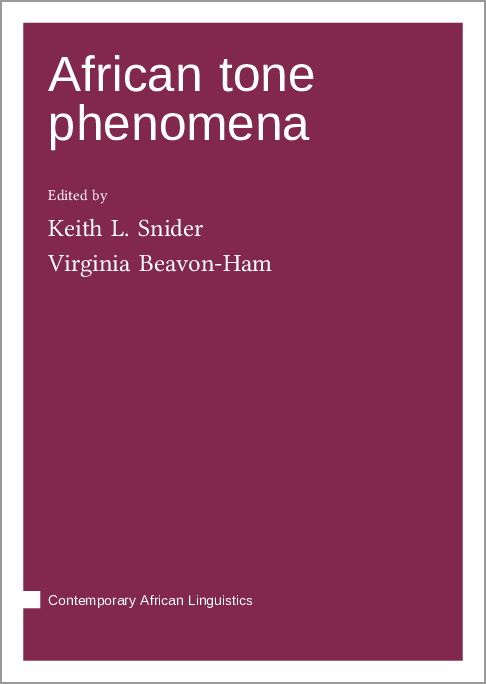
Forthcoming: African tone phenomena
Synopsis
A vital resource for emerging and seasoned linguists alike, African Tone Phenomena serves as a handbook and inspiration for rigorous research into under-documented African tone systems. The volume features 18 peer-reviewed chapters authored by leading linguists. Each chapter prioritizes clear description, employing theoretical terminology only as needed to illuminate the phenomena being discussed.
Following an introduction and a tribute, the volume is divided into two parts. Part 1 comprises seven chapters: six of these explore common tone phenomena such as tone spreading, downstep, and grammatical tone, alongside less common phenomena such as consonant-tone interaction and tonal polarity. The seventh chapter describes how linguistic tone influences vocal music and relates to surrogate languages like those of talking drums and xylophones. Part 2 has ten chapters devoted to tone phenomena found in specific language families and regions (e.g., Northwestern Bantu, Benue-Congo, and Mande).
Chapters
-
African tone phenomena in focus
-
Tone spread and shift
-
Grammatical tone in African languages
-
Tonal downdrift and downstep in African languages
-
Floating tones
-
Consonant-tone interaction
-
Tone polarity
-
Tone and music in Africa
-
Tone in Cushitic languages
-
Tone in Chadic languages
-
Tone in Nilo-Saharan
-
Tone systems in the Bantoid languages
-
Lexical and non-lexical tone in Mambiloid
-
Tone in Grassfields Bantu languages
-
Tonal systems in Benue-Congo and West Chadic A3 in Central Nigeria
-
Tone in Mande languages
-
Tone in Kru languages
-
Tone in Northwestern Bantu
Published
August 20, 2026
LaTeX source on
GitHub
Print ISSN
2511-7726
Cite as
Snider, Keith L. & Beavon-Ham, Virginia (eds.). Forthcoming. African tone phenomena. (Contemporary African Linguistics). Berlin: Language Science Press.
Copyright (c) 2026 Keith L. Snider, Virginia Beavon-Ham; Joshua A. G. Smolders, Nicholas Rolle, Larry M. Hyman, Lee Bickmore, Florian Lionnet, Mary Pearce, Douglas Pulleyblank, Laura McPherson, Christopher R. Green, James Roberts, Mirella L. Blum, Roger Blench, Bruce Connell, Cameron Hamm, Rachel Robinson, Pius W. Akumbu, Maria Konoshenko, Katherine R. Russell, Nadine Grimm