
We log anonymous usage statistics. Please read the privacy information for details.
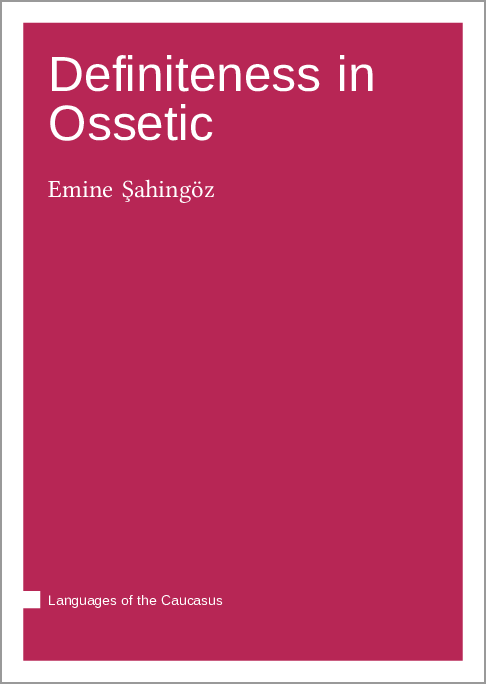
Forthcoming: Definiteness in Ossetic
Synopsis
How do languages mark what is already known to the listener? In the context of Modern Ossetic, an Indo-European language spoken in the Caucasus, this question leads to a complex interplay of case marking, particles, and prosody.
This study provides a comprehensive investigation into three distinct strategies used to express definiteness and topicality in Modern Ossetic. At its core is an extensive corpus-based analysis of Differential Object Marking (DOM), situating Ossetic within its broader areal and Iranian context. The author demonstrates how animacy and definiteness dictate case assignment, revealing that while animate referents are consistently marked, inanimate entities follow different, more restrictive regularities.
Beyond case marking, the volume offers a fresh discourse-analytical perspective on the topic particle i in Digor Ossetic. Challenging previous descriptions of i as a simple definite article, this research identifies its primary function in marking identifiable discourse referents and topicality. This functional approach is further extended to the loss of the particle i in Iron Ossetic, providing a diachronic and theoretical link between these two phenomena.
Furthermore, this volume study as one of the very few investigations to incorporate data from Anatolian Ossetic, a severely endangered variety of Modern Ossetic. By drawing on original linguistic examples, the study highlights specific tendencies in the language behavior of the Ossetic diaspora in Türkiye. This study provides a rare glimpse into the development of the language outside its core territory, offering new insights into how contact and isolation shape the grammatical and pragmatic structures of a heritage language.
By combining empirical data with a strong typological framework, this work contributes significantly to our understanding of the interface between syntax, semantics, and information structure in Modern Ossetic. It is an essential resource for linguists interested in Iranian languages, Caucasian typology, and the cross-linguistic study of definiteness.
Published
April 16, 2026
LaTeX source on
GitHub
Cite as
Şahingöz, Emine. Forthcoming. Definiteness in Ossetic. (Languages of the Caucasus). Berlin: Language Science Press.
Copyright (c) 2026 Emine Şahingöz