
We log anonymous usage statistics. Please read the privacy information for details.
Forthcoming: Variation in word meanings: Cross-linguistic patterns and causes of colexifications
Keywords:
Lexical typology, Colexification, Cross-linguistic database, Body part terms, VietnameseSynopsis
Humans use language to convey meanings through spoken or signed expressions. However, the way languages divide the world into words varies. For example, the word laŋ in the language Belhare denotes the part of the body that reaches from the hip to the toes. In comparison, English speakers divide this area into two words: foot and leg. Languages thus combine meanings and express them with the same word; a phenomenon called colexification. In the approximately 6,500-7,000 languages of the world, meanings are combined in a wide variety of ways. This raises the following questions: How can we study language variation in word meanings? What patterns of variation occur and what causes them? I investigate these questions in this book.
The aim of the book is twofold. First, language comparison is only possible if data are presented in a format that is accessible to humans and computers. Thus, I use a computer-assisted approach that provides a framework for managing large datasets and facilitates expert-driven reviews. This approach allows for both qualitative and quantitative analyses by integrating methods from computer science and linguistics. I illustrate the applicability of this approach by presenting a lexical database with data on words and concept properties for 39 languages.
Second, language variation in word meanings is not random. While language is a product of history, culture, cognition, and coincidence, disentangling the different effects is a challenge. Yet, there are similarities in the way languages structure their vocabularies, which is evidence that there are constraints. By focusing on common cognitive dimensions that lead to the connections of certain meanings, the studies provide insights into overarching patterns.
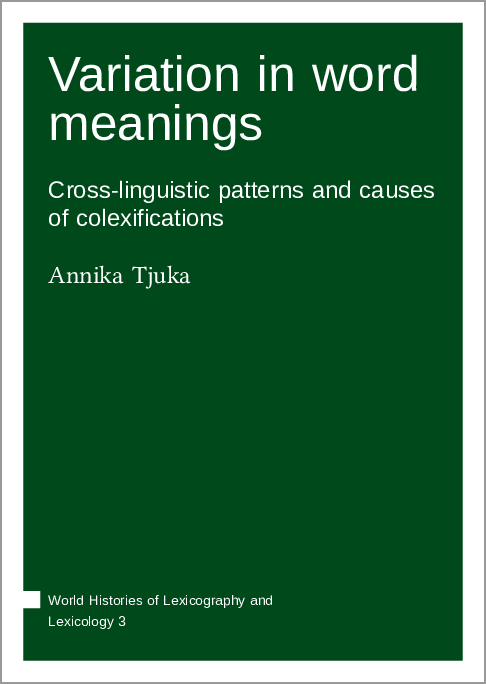
Published
June 9, 2026
LaTeX source on
GitHub
Cite as
Tjuka, Annika. Forthcoming. Variation in word meanings: Cross-linguistic patterns and causes of colexifications. (World Histories of Lexicography and Lexicology 3). Berlin: Language Science Press. DOI: 10.5281/zenodo.20639912
Copyright (c) 2026 Annika Tjuka
Details about the available publication format: PDF
PDF
ISBN-13 (15)
978-3-96110-587-8
doi
10.5281/zenodo.20639912
Details about the available publication format: Hardcover
Hardcover
ISBN-13 (15)
978-3-98554-204-8
Physical Dimensions
180mm x 245mm