
We log anonymous usage statistics. Please read the privacy information for details.
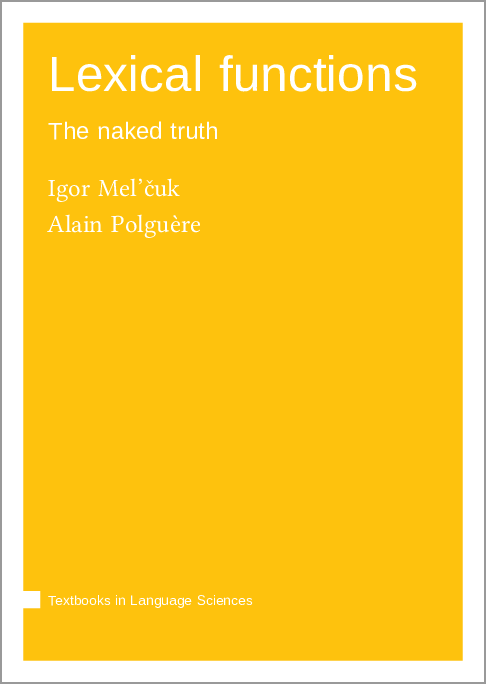
Forthcoming: Lexical functions: The naked truth
Synopsis
This book introduces lexical functions, a formal tool which ensures a systematic homogeneous description of two complementary families of relations between lexical units:
- derivations – paradigmatic lexical functions;
- collocations, which are constrained lexical combinations – syntagmatic lexical functions.
Each lexical function is associated with a specific meaning and once it is applied to a given lexical unit, which is seen as its argument, the function returns, as its value, the set of (near-)synonymous lexical entities which express this meaning depending on the argument. As an example, the paradigmatic lexical function {S₁} is associated with the meaning 'someone/something which does/is...', and the syntagmatic lexical function Magn is associated with the meaning 'very'/'intense(ly)' as illustrated below.
- S₁ (felony) = felon
- S₁(gossipᵥ) = gossiper; busybody
- S₁(disappointing) = disappointment; bummer
- Magn(penalty) = harsh, heavy, hefty, severe, stiff
- Magn(fightᵥ) = fiercely, ⌜to the bitter end⌝, ⌜tooth and nail⌝
- Magn(bored) = stiff [~], ⌜to death⌝, ⌜to tears⌝
The volume describes and illustrates (for English, French and Russian) the system of 66 simple standard lexical functions, which can be combined to form complex and configurational lexical functions. Standard lexical functions are language-universal: they seem sufficient for the description of standard derivations and collocations of any language. (For unique and deviating derivations and collocations non-standard lexical functions are assumed.) Balancing conceptual depth with pedagogical effort, Lexical functions: The naked truth guides readers from foundational notions to the full system of lexical functions, concluding with their role in modeling the network structure of natural language lexicons.
Published
July 6, 2026
LaTeX source on
GitHub
Print ISSN
2364-6209
Cite as
Mel'čuk, Igor & Polguère, Alain. Forthcoming. Lexical functions: The naked truth. (Textbooks in Language Sciences). Berlin: Language Science Press.
Copyright (c) 2026 Polguère Alain, Igor Mel'čuk