
We log anonymous usage statistics. Please read the privacy information for details.
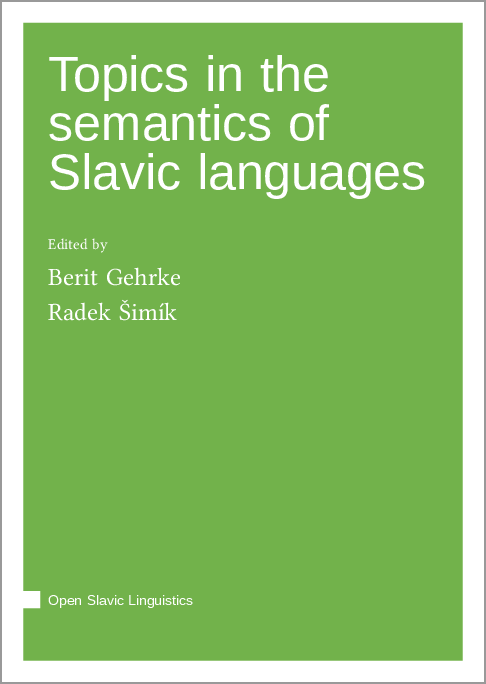
Forthcoming: Topics in the semantics of Slavic languages
Synopsis
Topics in the semantics of Slavic languages contains twelve chapters devoted to a particular topic in formal semantics, as well as an introductory chapter. The topic chapters all consists of two parts: an overview part and a new analytical contribution or case study. The volume fulfills a number of goals: (i) to summarize existing analyses and theories, (ii) to provide a representative bibliographic overview of the relevant literature, (iii) to demonstrate what Slavic data and theories built upon them have to offer to the general linguistic discourse, and (iv) to provide a novel theoretical and/or empirical contribution. The chapters in this collection discuss data from the following Slavic languages: Bosnian/Croatian/Montenegrin/Serbian (BCMS), and more specifically Croatian and Serbian, Bulgarian, Czech, Macedonian, Polish, Resian, Russian, Slovak, Slovenian, Upper Sorbian, and Ukrainian.
The collection is of interest to a broad readership – Slavic as well as general linguistic scholars, experienced researchers as well as advanced undergraduate or postgraduate students. Individual contributions can serve as background reading to topical seminars. The volume covers areas of semantics in which Slavic languages have traditionally or more recently played an important role in the general formal semantic discourse (e.g. aspect, event structure, genericity, tense, information structure, negation and NPIs, (in)definiteness and specificity, bare NP semantics), as well as topics that have received less attention in their application to Slavic languages, but are pertinent to the theory of semantics, including its interfaces (e.g. focus participles, questions, imperatives, numerals, passives).
Chapters
-
The semantics of Slavic languagesAn introduction
-
Bare nominals and definiteness in Russian
-
Negative polarity items in Slavic
-
Genericity and habituality in Czech
-
Cross-Slavic aspect, passives, and temporal definiteness
-
Indefiniteness and specificity in Slavic languages
-
Tense in Slavic
-
The morphosemantics of Russian aspect
-
Polar question semantics and bias: Lessons from Slavic/Czech
-
Lessons from Slovenian imperatives
-
Event structure and derivational morphologyA few reflections on the system of Russian
-
Family of exclusives in Polish
-
Numerals and their kinThe view from Slavic
Published
December 10, 2025
LaTeX source on
GitHub
Cite as
Gehrke, Berit & Šimík, Radek (eds.). Forthcoming. Topics in the semantics of Slavic languages. (Open Slavic Linguistics). Berlin: Language Science Press.
Copyright (c) 2025 Berit Gehrke; Olga Borik; Radek Šimík; Mojmír Dočekal, Hana Filip, Ljudmila Geist, Atle Grønn, Olav Mueller-Reichau, Adrian Stegovec, Sergei Tatevosov, Barbara Tomaszewicz-Özakın, Marcin Wągiel